Financial AI is Stuck at Step One
We are drowning in AI tools that can read, but starving for AI that can actually reason.

Alistair Smallwood
Head of Applied AI
Insight
For eight years, my job was to broke stocks to buyside analysts and PMs. I spoke to them every single day, and I thought I knew their workflow inside out. I didn’t. It wasn’t until I moved to the buyside and sat in that seat myself that I truly understood what the day to day reality of the job actually looks like.
That fundamental disconnect is why so much of the current AI landscape misses the mark. Over the last two years, I have trialled basically every tool I could get my hands on. What I have learned is that while most of these tools are excellent at making you faster at reading and searching, that is not where they earn a permanent place on a desk. Past step one of the research process, the tourist tools fall apart. The founders best placed to actually make a difference to your workflow are the ones who have lived it.
The winners of this cycle will not be the best summarisers; they will be the systems that sit embedded within real workflows, close enough to decisions to reduce cognitive load rather than add to it.
This essay explores why the current wave of tools fails past Step 1, what agentic actually needs to mean in equity research, and why the edge is shifting from basic information access to long horizon judgement.
If you feel oddly numb to AI in investing right now, you are not alone. The stream of demos is relentless, the claims are always maximal, and the lived experience for most people on a desk is familiar: you try a tool, it is clearly useful, you add it to the stack, and then it quietly stops earning the right to be opened.
The problem is that experimentation is cheap and adoption is not. Most analysts and PMs do not have the spare capacity to rebuild workflows around a new tool, teach a team, debug edge cases, and develop the muscle memory that turns a nice demo into default behaviour. That is a rare combination on a live desk.
The App Store phase of finance is about workflow improvement, not just new apps
In tech, there are rare moments where a tool moves from “faster” to “newly possible.” The early consumer App Store was one of those moments; it was not just a collection of apps but a new surface that unlocked entirely new behaviour.
Fundamental equity research does not have that kind of blank canvas. The workflow we are talking about is already digital, sometimes aggressively so. It lives in terminals, spreadsheets, PDFs, email threads, vendor feeds, internal notes, and a hundred little systems that all claim to be the system of record. The bottleneck is rarely getting the information. The bottleneck is whether you can turn an endless stream of information into a coherent view, and then keep that view coherent as the world changes.
In this environment, utility is the grind of improvement: fewer repeated steps, fewer missed details, less time rebuilding context, and more time spent on the part of the job that actually generates alpha.
This is exactly why the current tool landscape looks the way it does. Developers are trying to shave time off existing tasks, which is why most equity research AI falls into two broad buckets:
Mass context absorption: Tools that compress transcripts, filings, and expert calls into something you can navigate and absorb quickly.
Model acceleration: Tools that pull data into spreadsheets, map line items, and shrink time spent doing spreadsheet mechanics.
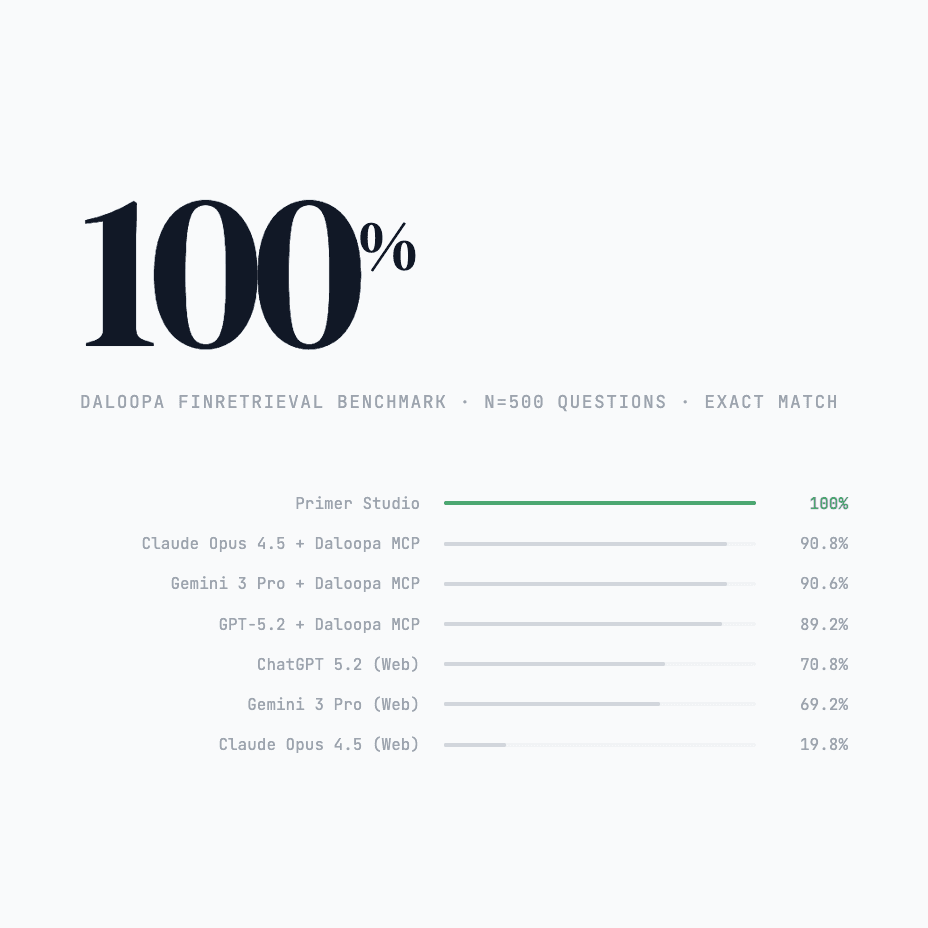
The industry is currently obsessed with the accuracy of these tools. Firstly, building is model is never about the output, it’s about the process and understanding you gain while doing it, something that has bypassed all the AI modelling tools on the market currently. Equally, think about how you evaluate a new graduate on your desk. You worry about their accuracy for about a week. Once they prove they can pull the right numbers and map the right line items without making mistakes, that just becomes table stakes. From that point on, they rarely get things wrong, and you stop judging them on data retrieval. You start judging them on analysis, inference, contextual understanding, and ultimately, judgement.
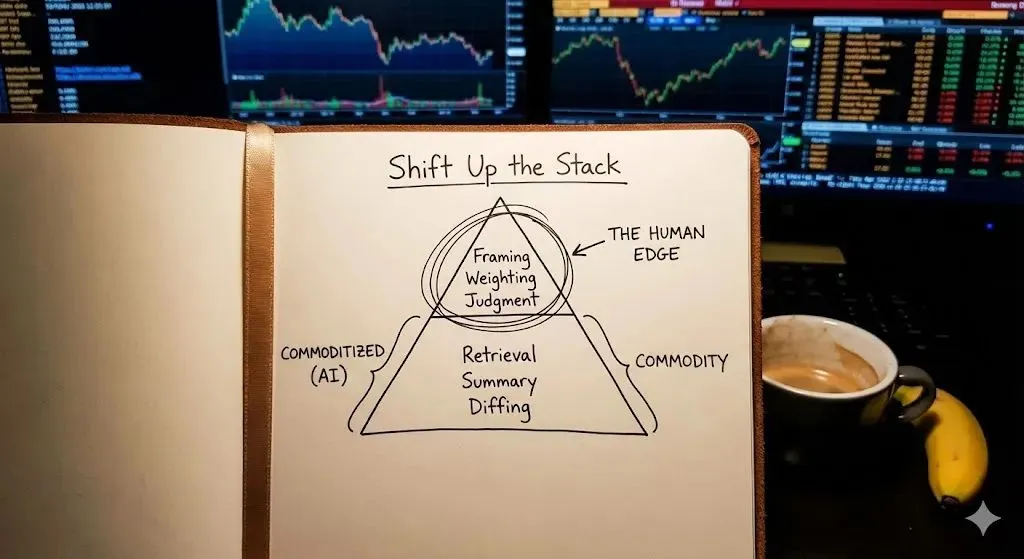
AI is no different. Both of these tool categories are useful, but neither is aimed at the deeper layer of the job: building and maintaining judgement over time.
The barrier: Real research is a decision problem, not a document problem
Getting up to speed on a company or theme is Step 1. The first wave of AI is genuinely good at this top of the funnel orientation. The tools out there are great at this mass context absorption. But to be honest, if you can prompt and are willing to attach the context yourself, so is any foundational LLM.
The trouble is what happens next. Once you are past the first read, the task stops looking like a document problem and starts looking like a decision problem. Investing is inherently about nuance. You cannot just summarise everything, or you erase the exact details you need to actually make a call.
Most AI products are built around the unit of work being a prompt. You ask, it answers. That is fine for orientation, but it starts to fray when you want the system to behave like a thoughtful analyst. In practice, most AI today acts like a faster intern: excellent at first drafts and grunge work, but less reliable because it simply does not think like an analyst.
The next benchmark for AI is decision leverage, not just accuracy
As we established with the graduate analogy, accuracy is a treadmill. It is a product requirement, but it is not a differentiator. Once everyone can retrieve the same documents and move numbers into spreadsheets with comparable reliability, the benchmark has to move to decision improvement.
Frankly, it means just better research: the opinionated output of the process, rather than just regurgitation or summarisation. Opinion is the critical missing piece in the current landscape because an opinion is a function of judgement and that is exactly what none of the current AI tools are doing.
As information gets cheaper, long horizon judgement becomes the ultimate edge
We are moving toward a world where near term information is cheaper, faster, and more evenly distributed. The friction between something happening and everyone knowing it keeps collapsing. When that happens, the edge from being first compresses. Alpha does not disappear; it migrates.
It migrates outward in time horizon and upward in abstraction. As information gets cheaper, judgement becomes more valuable. The AI products that matter most will not be the ones that help you read faster, but the ones that strengthen the process by which you decide.
True AI agents must act like a tireless buyside colleague
Most talk about AI “agents” in finance is really just basic automation with a better label. While fetching documents or filling cells is useful, a real agent in equity research needs to be far more robust: it should think and behave like a colleague with unlimited attention and no requirement to sleep.
It must be able to execute the next layers up of skill. A true agent needs to process the data, but then it needs to be able to call you out when your logic breaks. It needs to be able to relative weight new information for the stock, separating the noise from what actually moves the needle. It must be capable of doing the work you simply do not have time to do, and executing it to a very high standard.
Crucially, it needs to do all of this autonomously from a few simple instructions, while allowing you to encode your own specific methods and ways of looking at a business. That is what agentic should mean here: an extension of your own analytical process.
The future belongs to workflow native intelligence
Tool sprawl is a phase, not a destination. The products that win will be the ones that sit embedded within real workflows, reducing cognitive load rather than adding to it. The next generation is not better chat. It is workflow native analyst intelligence, embedded where decisions are made, designed to strengthen judgement as information itself becomes cheaper and more perfect.