Primer vs AlphaSense: Which Platform Is Better for Institutional Equity Research?
For fundamental analysts and PMs deciding where to spend time and tooling budget, this comparison matters because Step 1 and Step 2 are different jobs. If you are comparing Primer and AlphaSense, the practical split is simple: AlphaSense is strongest at Step 1, finding and scanning information across a broad universe, while Primer is strongest at Step 2, developing, testing, and maintaining an investment idea until it is actionable.

Alistair Smallwood
Head of Applied AI
Insight

Where AlphaSense Is Strong
Breadth of discovery: AlphaSense can search a very large set of filings, transcripts, and premium external sources, including sell side research and expert network content.
Speed of monitoring: AlphaSense helps teams scan a wide universe quickly and stay current.
Pull based research: if your workflow is mainly analyst-directed search and retrieval across many names, AlphaSense is a strong fit.
Where Primer Is Strong
Primer is strongest where analyst quality is required: in the model, in assumptions, in comparability work, in generating insights, and in spotting what matters before it becomes obvious. Primer deliberately focuses on primary company materials and related research inputs, not expert network or sell side content, because inherited external framing can introduce bias before an analyst forms a first principles view.
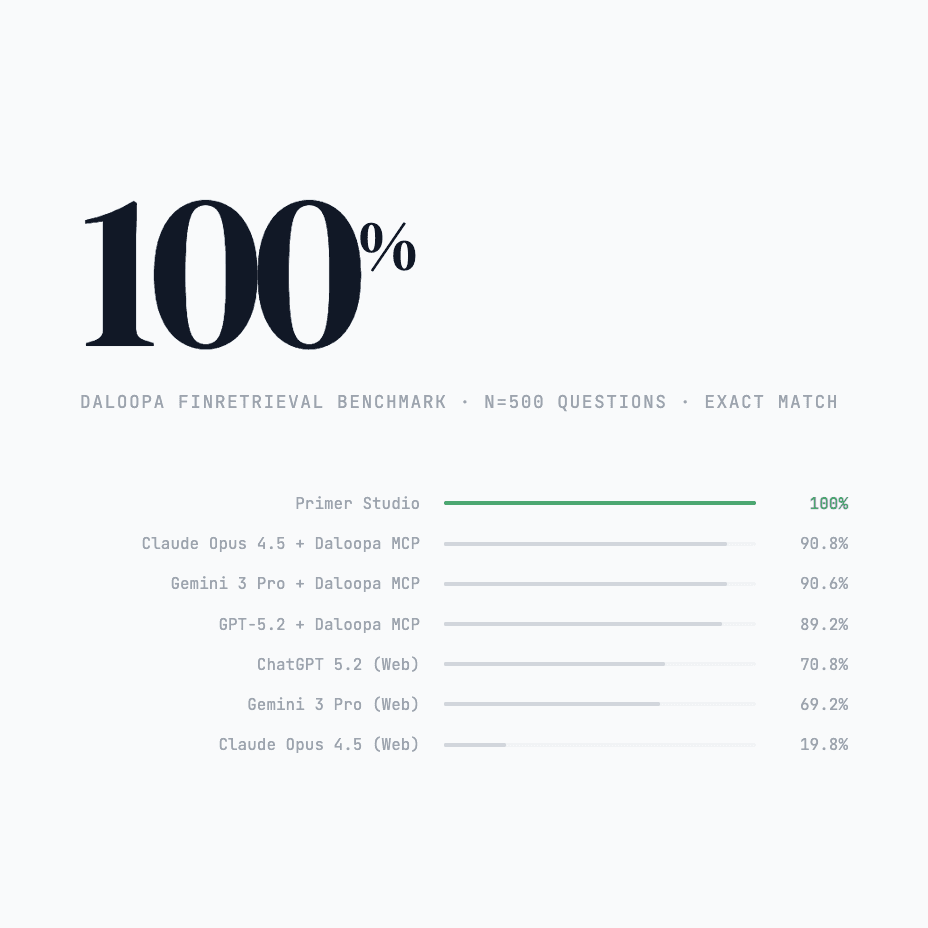
Primer does the analytical work, not only compression: Primer can take a specific investment angle, retrieve evidence with high reliability, run web research, and execute the analysis into either model outputs or text outputs. The value is not only time saved on document digestion. The value is whether the system helps analysts do the hard work that generates ideas: structuring assumptions, testing scenarios, comparing peers properly, and maintaining a coherent thesis through new information.
Primer is flexible across the full workflow: every desk works differently, and Primer supports desk-specific customisation across inputs, methods, rules, thesis framing, and output format. That includes ROIC definitions, accounting treatments, house conventions, and the specific investment angle being tested. This creates analytical consistency across analysts and across quarters.
Primer preserves and compounds work: a common failure mode in institutional research is quarterly reset, where assumptions get rebuilt, context gets lost, and model history becomes hard to trust. Primer is designed for continuity, so assumptions, notes, and rationale stay attached to the work and remain usable as the thesis evolves.
Primer pressure tests your view: Primer does not only help build a case. It can surface contrary evidence and challenge anchored assumptions so the thesis is tested, not simply confirmed.
When AlphaSense Is the Better Choice
AlphaSense is likely the better choice if your primary bottleneck is:
Broad discovery across many sources and topics
Heavy dependence on premium external corpora, including sell side and expert networks
Fast pull based monitoring across a very large universe
Quickly locating relevant passages and updates across many names
When Primer Is the Better Choice
Primer is likely the better choice if your primary bottleneck is:
Doing deeper investigative research rather than only summarisation
Building and maintaining high quality models at scale
Enforcing team methodology across analysts and coverage
Producing consistent earnings and read across workflows without constant rebuild
Preserving institutional reasoning so prior work stays usable instead of resetting
Running thesis-aware automated triggers that push what matters instead of relying only on manual pull
The Honest Tradeoff
This is not a winner takes all comparison. AlphaSense has stronger breadth in discovery, while Primer has stronger depth in execution, method control, and maintained research workflow. Many teams may use both: AlphaSense for broad discovery, and Primer for idea development, testing, and ongoing maintenance.
If you need to choose one budget line today, use this test. If your main pain is finding and scanning information, choose the product optimised for discovery. If your main pain is turning information into maintained analysis you can act on, choose the product optimised for execution. Step 1 time savings are useful, but on their own they do not reliably generate investment ideas.